

For businesses with a physical location, the objective of a digital advertising campaign is not always to generate an online purchase or a completed form.
Sometimes, the most valuable result is much simpler: get the potential customer to call, request directions or visit the location.
In these cases, directing a user from a programmatic advertisement to the company’s Google Business Profile can be an extremely effective and surprisingly underused strategy.
From Advertisement to Action
The traditional structure of a display advertising campaign is straightforward: Advertisement → Website → Conversion
But for businesses such as car dealerships, restaurants, shops, clinics, hotels, gyms or other physical locations, adding a website as an intermediate step is not always necessary.
Instead, consider: Advertisement → Google Business Profile → Action
Once someone has shown interest by clicking the advertisement, a Google Business Profile immediately presents several ways to continue.
Depending on the business and profile configuration, the user can:
Call the company
Request directions
Open the location in Google Maps
Visit the company’s website
View opening hours
Read reviews
View photos
Explore products or services
Make a reservation or appointment when supported
Google itself describes Business Profiles as a way for customers to find businesses through Google Search and Maps and access information including the company’s location, telephone number, website and opening hours. Some business categories can also provide additional action links for appointments, reservations, orders and other actions.
Reducing the Distance Between Interest and a Physical Visit
Every additional step after someone clicks an advertisement creates an opportunity to lose that person.
Imagine someone sees a mobile banner for a nearby car dealership.
They are interested and click.
If they arrive on the dealership’s homepage, they may have to find the address, locate the telephone number or search for the dealership in Google Maps before they can actually visit.
If the advertisement directs them to the dealership’s Google Business Profile instead, one of the most relevant options is immediately available: Directions.
A potential customer can go from seeing an advertisement to navigating toward the physical location in only a few interactions. For campaigns designed to generate physical visits, that can be a very logical user journey.
Mobile Makes This Particularly Interesting
This strategy is especially relevant for mobile programmatic advertising. The smartphone is not simply an advertising screen. It is also the device people use to call businesses and navigate to physical locations.
Someone seeing an advertisement while already relatively close to a store could click the advertisement, open the Google Business Profile and immediately request directions.
For that reason, combining this strategy with city targeting, GPS targeting or geofencing can create a particularly powerful campaign structure.
For example: Geofenced mobile campaign → Advertisement → Google Business Profile → Directions → Physical location
Instead of asking the consumer to navigate through a conventional website funnel, we provide immediate access to the action that actually matters.
Calls Can Be Just as Valuable
The same principle applies when telephone calls are important. Consider car dealerships, real-estate agencies, restaurants, repair companies or professional services.
A user might see an advertisement and simply want to ask:
“Are you open?”
“Do you have this model available?”
“Can I make an appointment?”
“Can I come by today?”
Sending this person to a complicated landing page can introduce unnecessary friction. A Google Business Profile can provide immediate access to the company’s telephone number and calling functionality.
Google itself recognizes calls and direction requests as important local actions in its advertising ecosystem. For physical businesses, these actions can represent meaningful steps between advertising exposure and an offline conversion.
Trust Is Another Important Factor
There is another advantage. A Google Business Profile provides information that doesn’t come exclusively from the advertiser. Potential customers can see the location on a map, opening hours, photographs and customer reviews.
For somebody who has never interacted with a company before, this additional information can provide valuable reassurance before making a call or visiting the location. In other words, the Google Business Profile doesn’t have to function simply as a destination.
It can function as the bridge between advertising interest and real-world action.
A Real Example: Targetoo
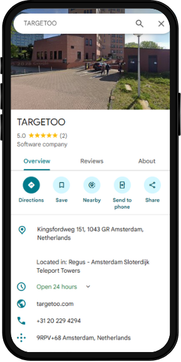
Example: the Google Business Profile of Targetoo’s Amsterdam office. A user interested in visiting the company can access practical information and actions directly from the profile.
Targetoo itself has a physical presence in Amsterdam at:
Kingsfordweg 151
1043 GR Amsterdam
The Netherlands
Imagine somebody in Amsterdam being served a Targetoo advertisement inviting them to visit us for coffee and a conversation about programmatic advertising.
Instead of sending that person through several pages of our website, the advertisement could link to our Google Business Profile.
From there, the interested person can immediately see where we are located, request directions, call us or continue to our website.
Simple.
This Doesn’t Mean Every Campaign Should Link to Google Of course, directing advertisements to a Google Business Profile isn’t appropriate for every campaign.
For e-commerce, lead-generation forms, detailed product explanations or campaigns where sophisticated conversion tracking is required, a dedicated landing page will usually remain the better option.
The important point is to consider the actual desired action before automatically entering a website URL as the destination of every campaign.
If the desired conversion is: “Visit this location” or “Call this business”
then ask yourself whether the company’s homepage really represents the shortest path toward that conversion.
Sometimes it does.
Sometimes Google Maps and the company’s Google Business Profile offer a much more direct route.
Test Both
As with almost everything in programmatic advertising, we recommend testing.
One campaign or creative can direct users toward a dedicated landing page, while another can direct interested users toward the company’s Google Business Profile.
Then evaluate the results.
For companies with multiple physical locations, this concept becomes even more interesting. Different geographically targeted campaigns can direct users toward the Google Business Profile of the specific branch closest or most relevant to that audience.
That creates a very straightforward structure: Right audience → Right location → Right advertisement → Right Google Business Profile → Call, directions or visit
Programmatic advertising is incredibly sophisticated behind the scenes. But sometimes improving campaign performance is simply about making the final step as easy as possible.
At Targetoo, that’s exactly what we like to test.