

After more than 14 years in programmatic advertising, one thing has become clear: the most valuable audiences are often not the biggest ones. They are the most understood.
That insight is what led Targetoo to introduce a new targeting framework—Contextual Research Targeting. Rather than relying heavily on expensive third-party data segments, this approach helps advertisers reach highly specific, niche audiences by combining strategic audience research with the deep technical targeting capabilities of a modern DSP.
In a landscape increasingly shaped by privacy regulation, rising data costs, and fragmented user behavior, Contextual Research Targeting represents a smarter, more sustainable way to build and activate audiences.
Why Traditional Audience Targeting Is Hitting Its Limits
For years, advertisers have leaned on pre-packaged third-party segments—interests, demographics, income brackets—purchased through external data providers. While convenient, these segments often come with trade-offs: higher CPMs, limited transparency, and minimal differentiation from competitors using the same data.
At the same time, bidstream-based targeting has grown increasingly complex and regulated. Massive volumes of data don’t always translate into better performance, especially when the goal is to reach specialized or hard-to-define communities.
Targetoo’s experience showed that many of these audiences already reveal themselves through consistent, observable technical and contextual patterns—if you know where to look.
What Is Contextual Research Targeting?
Contextual Research Targeting is built on a simple but powerful idea: research first, activate second.
Instead of starting with “Which data segment should I buy?”, advertisers begin by asking:
How does this audience actually behave digitally?
Using approximately 40 advanced targeting signals available within the Targetoo DSP—including device brand and model, OS version, carrier, IP range, device language, geolocation behavior, and frequently visited apps or websites—marketers can construct highly precise targeting scenarios.
When applied responsibly, these signals allow advertisers to identify audiences often considered fragmented, expensive, or difficult to reach—without relying on mass-scale third-party datasets.
Turning Digital Behavior into Actionable Insight
Years of campaign observation revealed a pattern: specific communities tend to cluster around recognizable combinations of technical attributes.
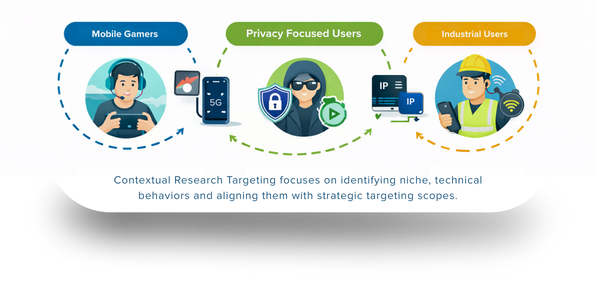
For example, mobile gamers often gravitate toward certain device models and high-performance networks. Privacy-conscious users show distinct behaviors around operating systems, carriers, and IP usage. Field workers and industrial users frequently rely on rugged hardware and enterprise connectivity.
Contextual Research Targeting doesn’t guess these patterns—it maps them deliberately and activates against them.
Examples of Contextual Research in Action
Smartphone-Centric Communities
Certain devices are specifically designed for certain users. Gaming-focused smartphones, privacy-first devices, rugged industrial phones, or ethically produced models each attract communities with shared values, behaviors, and digital habits. By understanding these patterns, advertisers can align messaging with real-world intent rather than generic assumptions.
Carrier-Based Behavioral Signals
Network choice often reflects usage style. High-speed, low-latency plans tend to correlate with streaming-heavy and gaming audiences. Family-oriented plans indicate shared-device households and parental controls. Regional and satellite-based connectivity points to rural, remote, or highly mobile users. These distinctions matter when relevance is the goal.
IP Environment Intelligence
IP-level context adds another dimension. Enterprise networks, cloud infrastructure, VPN and privacy networks, or university-owned IP ranges each signal different environments and user mindsets. When combined with other targeting layers, IP intelligence helps refine campaigns without crossing privacy boundaries.
The Cost Advantage: Building Audiences You Actually Own
One of the most compelling benefits of Contextual Research Targeting is cost efficiency.
Traditional third-party audience segments often add around $1.00 CPM on top of media costs—and those fees recur with every campaign. Over time, this significantly inflates budgets while offering little long-term asset value.
Targetoo’s approach flips this model.
By activating campaigns in carefully researched environments, advertisers can compliantly collect and build proprietary audiences—device identifiers and contextual clusters that can be reused, refined, and scaled over time. These audiences are not rented; they are owned.
The result is a growing first-party data asset that improves performance while reducing dependency on external data providers.
Why This Matters Now
As privacy frameworks evolve and third-party data becomes less reliable, advertisers need targeting strategies that are:
Transparent
Compliant
Cost-efficient
Insight-driven
Contextual Research Targeting answers all four. It replaces generic assumptions with deliberate research. It values understanding over volume. And it empowers advertisers to turn their own market knowledge into a competitive advantage.
Targetoo’s Invitation to Advertisers
With the launch of Contextual Research Targeting, Targetoo is opening the door for advertisers, agencies, and media buyers to co-create smarter targeting strategies—built on insight, not dependency.
The message is simple but powerful: Use your knowledge of your audience. Research intelligently. Build profitably.
In a programmatic world often driven by automation alone, Contextual Research Targeting brings strategy back to the center—supported by a capable DSP designed for precision.